
PoC Radios vs Traditional Two-Way Radios: Which Is Better for Your Team?
November 11, 2026Push-to-talk over cellular, usually shortened to PoC, has become a serious alternative to traditional two-way radios. Instead of transmitting directly between handsets or through your own repeater, a PoC radio sends your voice over 4G LTE or 5G mobile networks. That means a team member in Boston can talk to a driver in Dallas at the press of a button. But PoC is not right for every team. This guide compares PoC with traditional land mobile radio (LMR) so you can decide which, or which combination, fits your operation.
How PoC radios work
A PoC radio looks and feels like a walkie-talkie, with a big push-to-talk button, loud speaker and rugged housing. Inside, it has a SIM card and connects to a cellular network. When you press the button, your voice is sent as data to a PoC service platform, which instantly delivers it to everyone in your talk group, wherever they are.
Most PoC services also offer GPS tracking, a dispatch console, text and photo messaging, and in some cases video. You pay for the radio, a mobile data plan and a PoC service subscription.
How traditional two-way radios work
Traditional LMR radios, such as Motorola MOTOTRBO DMR radios, transmit directly to each other on licensed or licence-free radio frequencies. To cover a bigger area, you add a repeater. The network belongs to you, so it keeps working when cellular networks are congested or down.
PoC vs two-way radio at a glance
| PoC radios | Traditional two-way radios | |
|---|---|---|
| Range | Anywhere with cellular coverage, including nationwide | Line of sight between radios, or the coverage of your repeaters |
| Infrastructure | None needed; uses carrier networks | Optional repeaters and antennas for wider coverage |
| Licensing | No radio licence needed | Licence usually required (except licence-free bands) |
| Running costs | Monthly data plan and PoC subscription per user | Little or no ongoing cost after purchase |
| Reliability in emergencies | Depends on cellular network availability | Independent of cellular networks; direct mode always works |
| Call setup | Very fast, with slight network latency | Instant |
| Coverage indoors and underground | Limited where mobile signal is weak | Can be engineered with repeaters for basements, tunnels and large buildings |
| Best for | Dispersed teams, logistics, transport, multi-site businesses | Single sites, construction, events, industrial and emergency use |
When PoC is the better choice
- Your team is spread across a city, state or the whole country.
- You run delivery, logistics, taxi, field service or security patrol fleets.
- You do not want to manage radio licences, repeaters or antenna sites.
- Your teams already work where mobile coverage is strong.
Popular PoC options include the RugGear RG360, an affordable rugged PoC radio, the RugGear RG750, and the Motorola Evolve LTE handheld. See all models in our PoC radios category.
When a traditional two-way radio is the better choice
- You work on a single site such as a construction project, factory, warehouse, school, hotel or event venue.
- Communication must keep working during power or network outages.
- You work underground, in large steel buildings or in remote areas with weak cellular signal.
- You need instant group calls with zero monthly fees.
- You work in hazardous areas that require ATEX intrinsically safe radios.
Browse our portable two-way radios, including the Motorola MOTOTRBO R7, R5 and R2.
The best of both: hybrid radios
You no longer have to choose one or the other. Hybrid radios combine traditional two-way radio with LTE in a single device:
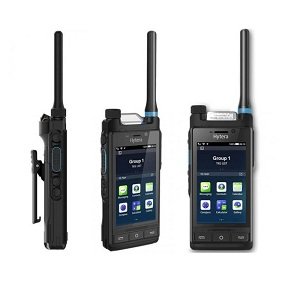
- Hytera PDC760 – a rugged Android device with both DMR and PoC, so users can talk on the local radio system on site and over LTE when they travel.
- Motorola MOTOTRBO ION – a MOTOTRBO DMR radio with 4G LTE, Wi-Fi and Android apps, giving you mission-critical voice plus smartphone-style data.
For public safety agencies, Motorola’s APX NEXT P25 radios also combine LMR with LTE broadband.
Our advice
If your team works on one site, a traditional two-way radio system is usually more reliable and cheaper to run. If your team is spread out and mobile coverage is good, PoC gives you unlimited range with no infrastructure. If you need both, a hybrid radio gives you resilience on site and reach everywhere else.
Tell us how and where your team works and we will recommend the right setup. Contact Radio Solutions Hub for expert advice and bulk quotes, or read our two-way radio buyer’s guide.