
DMR vs TETRA vs P25: Which Two-Way Radio Standard Is Right for You?
November 11, 2026Choosing a professional two-way radio usually starts with one question: which digital standard should your team be on? The three you will hear about most are DMR, TETRA and P25. All three turn your voice into digital data, all three beat old analogue radios on audio quality and battery life, and all three are used by serious organizations around the world. But they were designed for different users, and picking the wrong one can mean paying for features you never use or missing the ones you need.
This guide explains how each standard works, who it is built for, and which Motorola radios run on it, so you can make the right call for your business, site or agency.
Quick comparison: DMR vs TETRA vs P25
| DMR | TETRA | P25 | |
|---|---|---|---|
| Developed by | ETSI (Europe) | ETSI (Europe) | APCO / TIA (North America) |
| Typical users | Businesses, construction, security, hospitality, manufacturing, utilities | Public safety, transport, airports, utilities and large industry (mainly outside North America) | Police, fire, EMS, federal and military users in the US and Canada |
| Channel access | 2-slot TDMA in 12.5 kHz | 4-slot TDMA in 25 kHz | Phase 1 FDMA (12.5 kHz) / Phase 2 2-slot TDMA |
| Key strength | Affordable, flexible, easy migration from analogue | Large trunked networks, high capacity, telephony-style features | Interoperability between agencies, mission-critical reliability |
| Relative cost | $ | $$ | $$$ |
| Motorola examples | MOTOTRBO R2, R5, R7, DP4800e, SL1600 | MXP600, MTP3550, MTP8550Ex | APX 6000XE, APX NEXT, SRX 2200 |
What is DMR?
Digital Mobile Radio (DMR) is an open standard published by ETSI and is the most widely used digital radio technology for business and industry. It uses two-slot TDMA, which means one 12.5 kHz channel carries two separate voice or data conversations at the same time. You effectively double your channel capacity without buying more licences.
DMR comes in tiers. Tier II covers conventional licensed radio systems, which is what most businesses use, while Tier III adds trunking for larger, multi-site networks. Motorola’s DMR platform is called MOTOTRBO, and it adds extras such as enhanced noise cancellation, Wi-Fi programming, GPS location, text messaging, lone worker and man-down alerts.
Because most DMR radios can also operate in analogue mode, you can move a fleet from analogue to digital gradually, which keeps upgrade costs manageable.
DMR is the best fit if you run a security company, construction site, warehouse, hotel, school, hospital, event or factory, and you want clear audio, long battery life and useful data features at a sensible price.
Popular choices include the rugged MOTOTRBO R7 and R5 portable radios, the slim SL1600 for customer-facing staff, and DM4600e mobile radios for vehicles. To extend coverage across a large site, pair them with a MOTOTRBO repeater such as the SLR 5500.
What is TETRA?
Terrestrial Trunked Radio (TETRA) is also an ETSI standard, but it was designed from the start for large trunked networks operated by public safety agencies and critical infrastructure. TETRA fits four time slots into a 25 kHz channel and is built around a central switching infrastructure, which gives it very high capacity and advanced call features.
TETRA radios support group calls, individual calls, full-duplex telephone-style calls, status messaging, packet data and strong air-interface encryption. It is the backbone of emergency service networks across Europe, the Middle East, Asia and Latin America, and is common at airports, metros, ports, oil and gas facilities and utilities. It is far less common in North America, where P25 dominates public safety.
TETRA is the best fit if your organization already operates on a TETRA network, or you are a transport, utility or industrial operator that needs a large, high-capacity trunked system.
Browse our Motorola TETRA radios, including the compact and loud MXP600, the MTP3500 and MTP3550, and the ATEX-certified MTP8500Ex and MTP8550Ex for hazardous areas.
What is P25?
Project 25 (P25) is the digital radio standard developed by APCO and the TIA for North American public safety. Its main goal is interoperability: a P25 radio from one manufacturer can talk to a P25 radio from another, so police, fire, EMS and federal agencies can work together at the same incident.
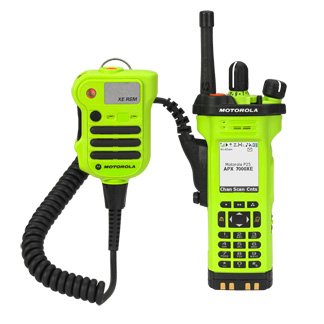
P25 Phase 1 uses FDMA with one voice path per 12.5 kHz channel. Phase 2 uses two-slot TDMA to double capacity, similar to DMR. P25 radios are built to the highest standards for audio, durability and encryption, and many are designed for firefighters who need oversized controls they can use with heavy gloves.
P25 is the best fit if you are a US or Canadian public safety agency, a federal or tactical team, or an organization that must interoperate with these agencies.
Explore our Motorola APX P25 radios, from the fire-ready APX 6000XE and APX 7000XE to the APX NEXT smart radios with LTE, and the military-specification SRX 2200.
How to choose: five questions to ask
- Who do you need to talk to? If you must interoperate with public safety agencies in North America, you need P25. If you are joining an existing TETRA network, you need TETRA. For an independent business fleet, DMR is usually the right answer.
- How big is your network? A single site is easily covered by DMR radios and, if needed, one repeater. Regional or national networks with thousands of users are where TETRA and P25 trunking shine.
- What is your budget? DMR radios cost a fraction of P25 radios. For most commercial users, the extra spend on P25 brings little practical benefit.
- Do you work in hazardous areas? All three standards are available in intrinsically safe versions. See our ATEX radios for oil, gas and chemical sites.
- Do you need nationwide coverage without infrastructure? Consider push-to-talk over cellular (PoC) radios, or a hybrid such as the Motorola MOTOTRBO ION that combines DMR with 4G LTE.
Our recommendation
For the vast majority of businesses, DMR (MOTOTRBO) offers the best balance of performance, features and cost. Choose TETRA when you are part of a TETRA network or need large-scale trunking outside North America, and choose P25 when mission-critical interoperability with public safety is non-negotiable.
Still unsure? Read our two-way radio buyer’s guide or contact our radio specialists. We will recommend the right standard and models for your team and send a quote for bulk orders.